School Roofing in Rockford, IL
K-12 school roof repair, recover and replacement in Rockford, IL, timed around the school year and built for snow load and freeze-thaw. Get an honest read.
School Roofing
School Roofing
Rockford, IL
A school roof does its hardest work between December and March, when snow banks against the gym wall and every thaw sends meltwater looking for a way down into a classroom ceiling. Rockford, IL averages about 36 inches of snow a year and about 134 days at or below freezing, so a school roof here goes through hundreds of freeze and thaw swings over its life. The weak spots are always the same ones: seams, flashings, drains, and the metal around boiler flues and rooftop curbs. Rockford Public School District 205 tops the city's employer list at about 4,075 people, and a school district that large may well own buildings from several eras, which can mean roofs at very different stages of wear.
If you look after a school building, do not wait for a ceiling tile to drop before you find out what is under the membrane. Get a plain written read on the roof while you still have a full summer to plan the fix and time to compare prices.
Read what snow and thaw do to a school roof
Schools are built in pieces. A tall gym or auditorium sits beside a lower classroom wing, a cafeteria and a mechanical room, and the roofs step up and down between them. Snow blows off the high roof and settles on the low one in deep drifts, so a section of roof that was sized for ordinary snow ends up carrying far more than its neighbors. The drift melts slowly against the wall, the water runs along the roof-to-wall flashing, and any gap in that flashing becomes a leak that shows up two rooms away. Roof drains and scuppers add to the trouble. Leaves and grit collect in them over the fall, and a drain that is half plugged in November will freeze solid in January and leave a pond sitting on the membrane.
On November 10, 2020, hail of 1 inch fell in Roscoe while Winnebago recorded a 73 mph gust, and a school roof with loose edge metal or aged seams is exactly what that kind of wind finds. Have the edges and drains checked every fall, before the first hard freeze, and have the roof looked at again after any storm that bent fences or took down trees.
Schedule the work around the school calendar
The best reroofing weeks for a school are the same weeks the students are gone. Membranes need a dry deck and mild temperatures to be welded or bonded properly, and in northern Illinois that window runs from spring thaw to late fall. Summer break sits in the middle of it, which is why every district wants the same few weeks and why material orders and crew schedules fill up early. Districts usually buy roofing through a formal bid, so the practical advice is to have the scope written and the roof tested by winter, bid it in the late winter or early spring, and order materials before the rush.
If a roof cannot wait for summer, occupied building reroofing is routine work for us. We stage the job in sections, keep equipment and tear-off debris away from play areas and bus lanes, seal fresh air intakes while adhesives and hot work are going on, and agree on quiet hours around testing days and dismissal. Nothing about that is complicated, but it has to be written into the contract before anyone arrives.
Keep your budget safe from what lies under the membrane
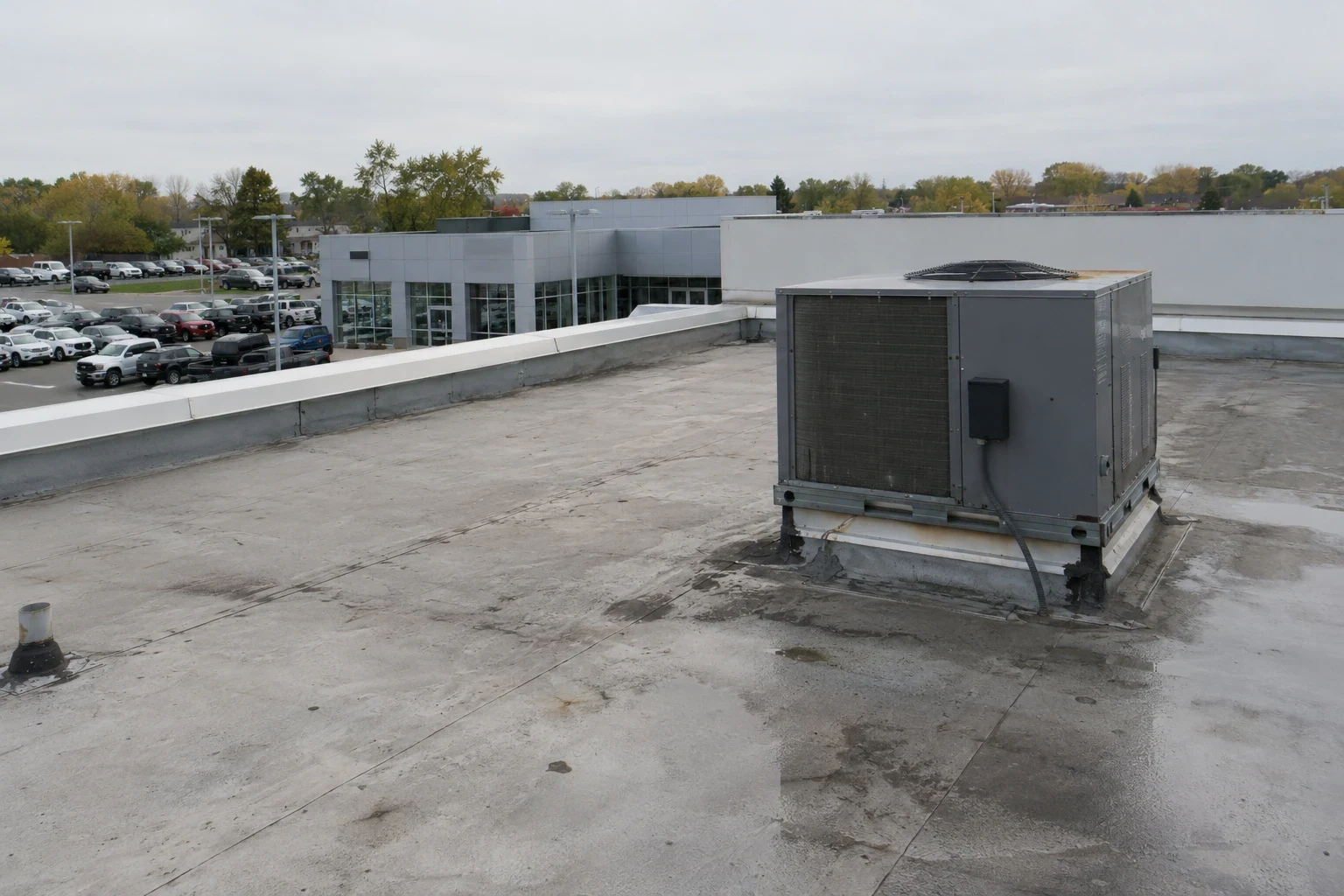
The membrane is only the visible part of a school roof. The surprises are underneath: insulation soaked from a slow leak, a rusted steel deck, or old roofing layers that have to be tested for asbestos before any tear-off. On an older school building any of those can turn an agreed price into a change order halfway through July. A moisture survey followed by a few core cuts shows how much of the insulation is wet and where, so the bid can carry an honest number instead of a guess.
Illinois put a new energy code into force at the start of 2024, rooted in the 2021 International Energy Conservation Code, so a replacement has to carry the insulation that code asks for. Ask every bidder to price wet insulation as a unit cost per square foot and to price the code upgrade as its own line, so you can compare bids on the same footing. A district that plans its roofs building by building, through roof capital planning, can spread the spending over several budget years instead of facing three failed roofs at once.

Match the fix to each building's future
Two schools with the same leak can need different answers. Winnebago CUSD 323 runs one high school, one middle school and two elementary schools. In a district with four schools, one failed roof can disrupt a large share of the classrooms, which is a strong argument for catching small defects early and watching every roof closely. Pecatonica High School, which opened in 2003, runs to roughly 107,000 square feet. On a building that size, a few core cuts cost very little next to the roof area they protect, and they tell you a great deal about what the next ten years will cost.
Then there are buildings whose future is uncertain. Oregon CUSD 220 consolidated its schools after a 1993 junior high fire and a 2004 Rahn Elementary fire, and some of the older buildings were converted to other uses. If the building may change hands or change purpose, a long-life replacement is rarely the right call, and a targeted repair or a recover overlay may buy the time you need. If the building will serve students for decades, we will say so and price the full replacement beside the repair.
Ask these questions before you sign
Put the following to every contractor in writing, and hold on to the answers.
- Who tests the old roofing for asbestos, and what happens to the schedule if it is found?
- Where will the crane, the dumpsters and the material trucks sit during school hours?
- What is the unit price for replacing wet insulation or damaged deck?
- How is the fresh air intake protected when adhesives are in use?
- What will the roof need from the district over the next ten years, and is that written down?
A contractor who answers all five plainly is worth a second look. One who cannot is selling you a price, not a plan. The same few dry months apply to college and university roofs, including a campus as large as Rock Valley College's 217 acres at North Mulford and Spring Brook roads. A district with several buildings can also set up preventive roof maintenance so every roof is walked twice a year and small repairs get done before they become summer projects. A government-building roof has similar access controls, with separate procurement and occupancy rules.
Questions Owners Ask
Our gym roof leaks every February. Does the fix have to wait for summer?
No. The leak gets a repair now that will hold through the snow, and the larger work gets bid for the break. Have the temporary repair photographed so the summer bid starts from the same facts.
Why do our classroom ceilings stain after a thaw instead of during a storm?
Meltwater moves slowly. It follows drifts and ice along flashings and seams, so stains often show up days after the snow starts to go and well away from the actual opening.
How do we find out how much of the roof is wet?
Scan it and then cut cores. An infrared survey maps the likely wet areas, and the cores confirm them, so you pay to replace only the insulation that is truly soaked.
Does a district have to tear off the old roof?
Not always. A recover can work when the insulation is mostly dry and the deck is solid, and it saves the tear-off cost. Cores and a scan will show whether your building qualifies.
What does a roof report give a facilities director?
A written record with photos, drain and flashing conditions, the leak history and a ranked repair list. You can take it to a board meeting or hand it to another contractor to check.