
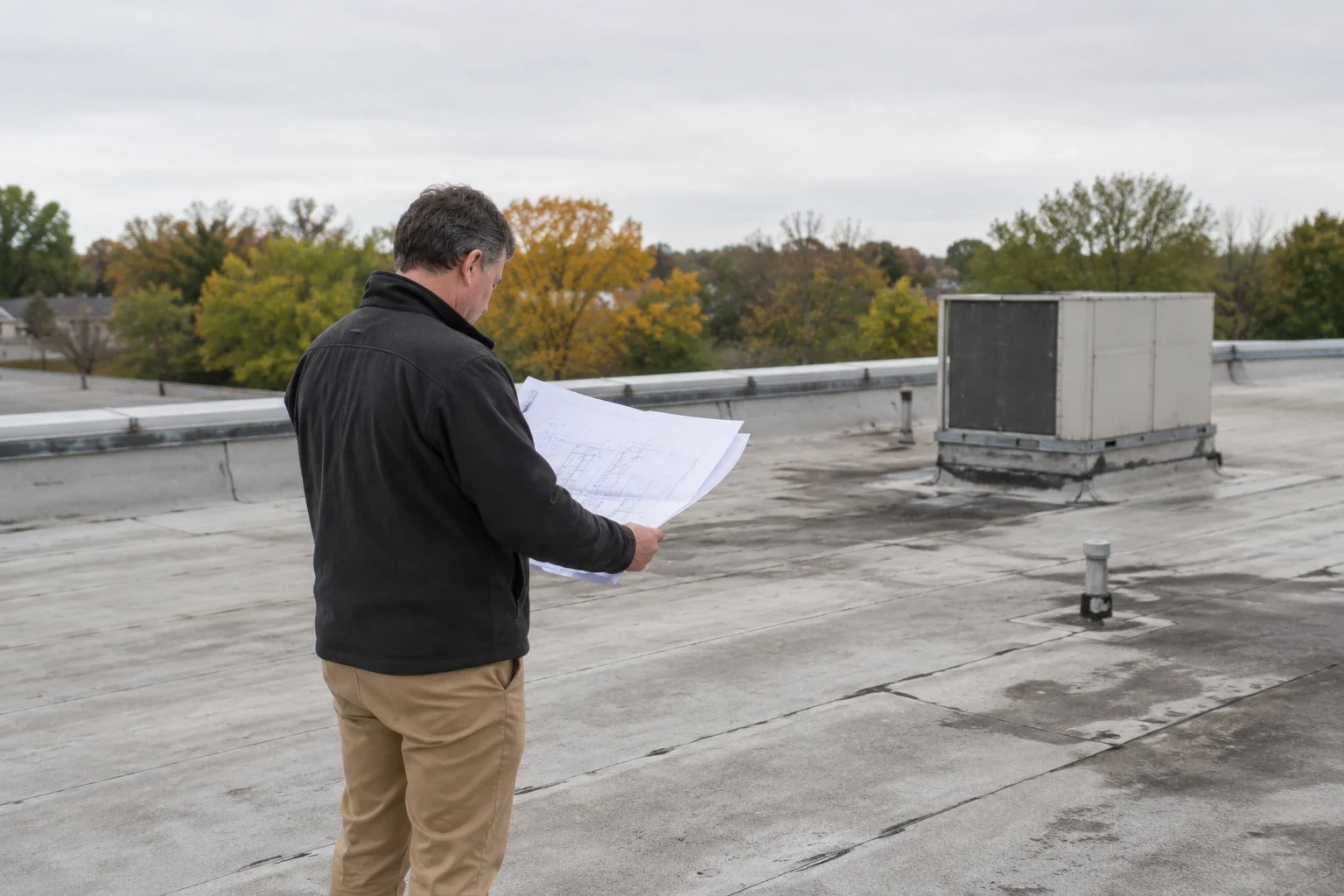
Roof Capital Planning in Rockford, IL
Plan roof repair and replacement budgets in Rockford, IL around real condition, code costs and winter timing so no single year takes a surprise hit.
Roof Capital Planning

Roof Capital Planning
Rockford, IL
The roof line in next year's budget gets written in the fall, and a Rockford winter edits it by March. Roughly 36 inches of snow lands on a typical year, the record winter of 1978 and 1979 put down 74.5 inches, and about 134 days sit at or below freezing, so a roof that was fine in the November meeting can be the emergency of the January thaw. Owners who plan only by the age of the membrane tend to pay twice, once for the repair that did not hold and once for the replacement it only delayed.
A capital plan is the cure for that. It lists each roof, its true condition, what it will probably need and the winter in which that work makes the most sense. Done, it lets you tell your board or lender a number you can defend. We will help you build it, and we will tell you where we think a line is padded.
Build the number from condition, not from the calendar
A twenty-year age on paper means little if the roof has stood in water for half its life or lost a corner to wind. We start with a written condition report for each building, with photographs, moisture findings and core cuts where they matter. From that, each roof gets an estimate of remaining useful life and a short list of defects that shorten it. Two roofs installed in the same year can be a decade apart in what they need.
Plan the budget in ranges, not single figures, because a roof opened for replacement can reveal wet insulation or a rusted deck that no survey could confirm. Ask for the range and for the reasons behind both ends. If a bidder only gives you one number, ask what it leaves out.

Sort every roof into repair, restore or replace
Each roof lands in one of three buckets, and the plan should say which one and why. A sound membrane over dry insulation with a few failed details belongs in repair. A tired but dry roof may be a candidate for coating and restoration, which spreads cost over more years. A roof with wet insulation or widespread seam failure usually needs replacement, and putting a coating over it only traps the water.
The mistake owners make is to leave a roof in the wrong bucket because it feels cheaper this year. A roof that should be replaced and gets patched three times costs more than the new roof would have, and a roof that is replaced too early wastes years of good membrane. Get the repair price next to the replacement price, every time.
Count what the energy code adds to a replacement
Plan the energy code into the numbers. Since January 1, 2024, Illinois has enforced its own energy code, built on the 2021 IECC, and the City of Rockford permits reroofing under the 2021 ICC family of codes. A permit for new roofing therefore pulls insulation levels into the scope. Expect the replacement to call for more insulation than the old assembly carried, and expect that extra depth to move your costs and raise the parapet and flashing details at every edge.
Budget for that before the bids arrive. A cover board and insulation scope that matches the code costs more than a swap of the membrane alone, and it is the part of the job that keeps heating bills down for the life of the roof. Ask your bidder to show the insulation depth in writing.
Stage replacements so no single year carries the load
Industrial and commercial owners in this region are watching large moves. Stellantis plans over $800 million to restart the Belvidere Assembly Plant, a roughly 5.3 million square foot complex, with pilot production expected in the first half of 2028, and about 258 acres beside the plant are planned as a supplier park near Belvidere. On the south side, Hillwood started a 335,000 square foot spec building at Rockford Logistics Park 20 in June 2026. New neighbors mean new contractor demand, and crews and materials get scarcer when everyone wants the same dry weeks.
Stage your own work early. Put the biggest replacements in the years with the most margin, book spring or summer starts well ahead, and leave winter for repairs and planning. A phased plan is easier to fund than a single year with three roofs coming off at once.
Hold a reserve for the storm you cannot schedule
No plan removes weather risk. The 1928 F4 tornado cut about 25.8 miles through Rockford's factory districts. In the November 10, 2020 storm, Roscoe and Rockton took 1 inch hail while Winnebago recorded 73 mph wind. An EF-1 touched down in Rockford on March 31, 2023. Any roof can lose a section to wind or hail, so the plan should carry a line for the unscheduled event, sized to your largest exposed building.
Pair that reserve with a written emergency response arrangement and a roof file that documents condition before the storm. When a claim does come, dated photographs and a recent report speak louder than a story told afterward. Owners in the South Rockford logistics corridor, where large new industrial buildings are going up, should treat that reserve as part of the budget and not as spare cash. Start the funding schedule with roof asset management records that name each system and condition.
A capital forecast should show how the recommendation changes if work is deferred, not simply place a replacement year on a spreadsheet. Separate urgent water-entry repairs from insulation, drainage and edge work that can be coordinated with a later project. Buildings near the East State Street corridor may have a different tenant turnover calendar from manufacturing properties in Loves Park, so timing affects both access and business interruption. Tie each proposed budget to inspection evidence and revisit the assumptions after major storms or roof alterations.
Questions Owners Ask
How far ahead should a roof budget reach?
Five years is the working horizon for most owners, with a longer view for any roof within a decade of replacement. The plan is revised each fall after the winter survey, so a roof can move up or down the list when the evidence changes.
My lender wants a reserve for roofs. How do I set the amount?
Start with the replacement range for each roof and spread it across the years you expect it to last, based on a recent condition report. Ratings backed by core cuts and moisture findings carry weight with a lender. Guesses based on age alone usually get challenged.
Should I replace a roof early to avoid a bad winter?
Only when the roof is already failing. A sound membrane still has useful years, and tearing it off early throws that value away. If the insulation is wet or the seams are splitting, waiting costs more. We will tell you which side of that line your roof is on.
Does a coating really push replacement back?
On a dry, sound roof, yes, by several seasons. On a wet roof it does not, and the trapped water will blister the new coating. That is why we scan and core before recommending one, and why we show you the numbers for both paths.
What does a good capital plan look like on paper?
One page per building with a rating, photographs, remaining life, planned work, a cost range and the year it is scheduled. A summary page shows the total by year. If a plan hides the reasoning or shows only a total, ask for the pages behind it.