Manufacturing Plant Roofing in Rockford, IL
Roof repair, recovery and replacement for Rockford, IL manufacturing plants, with chemical-resistant membranes, hot-work planning and straight pricing.
Manufacturing Plant Roofing

Manufacturing Plant Roofing
Rockford, IL
Snow tells the truth about a plant roof. It melts first above the paint line, the heat-treat bays and the exhaust stacks, and the pattern of bare spots on a winter morning is a map of where the building pushes heat, vapor and chemistry up into the membrane. In Rockford, IL that map matters, because the city's industrial base is aerospace, precision machining, fasteners and automotive supply, and the region holds about 7.2 times the national average in industrial machinery employment. Those buildings run hot inside and cold outside for about 134 days a year, and the roof sits on the line between the two.
If your plant roof keeps leaking in the same corner, do not keep patching it. Find out why that area keeps failing before you pay for another repair.
Read the roof for what the plant sends upward
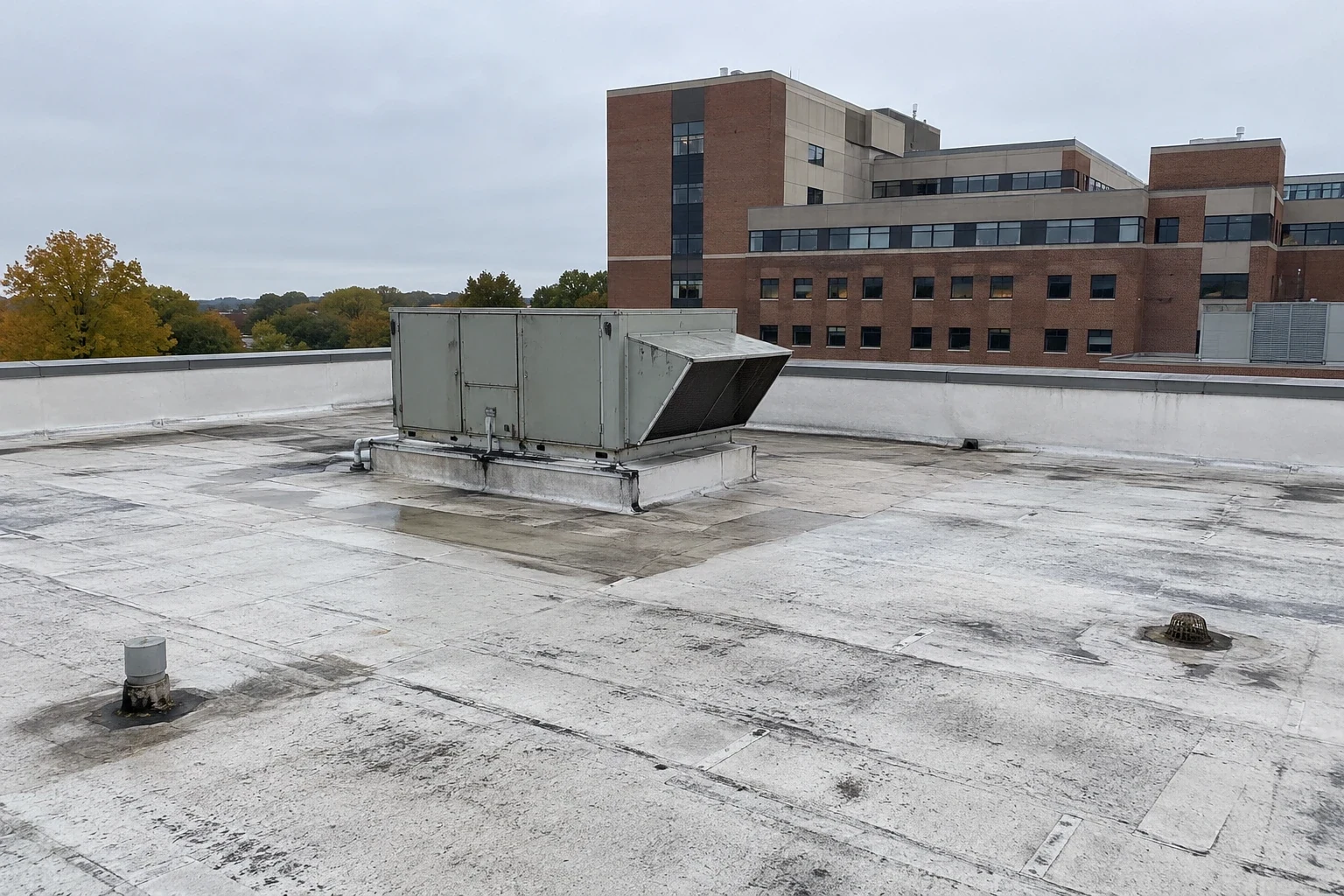
Weather and process stack their damage on a plant roof. Winter freeze and thaw pry at the seams, and summer brings about 15 days a year above 90 F, which a dark membrane turns into far hotter surface temperatures. Meanwhile exhaust fans spit warm, damp, sometimes oily air onto the surface, hot flue gases bake the sheet near stacks, and machining coolant mist and paint overspray settle across the downwind side. Built-up and mod-bit roofs on older plants and flex industrial buildings often carry layers of patches that were never matched to the chemistry coming off the equipment.
Weather has taken factories apart in Rockford before. The September 14, 1928 tornado tracked about 25.8 miles through the city's factory districts and collapsed buildings such as Rockford Chair and Furniture Company Factory B. A March 31, 2023 EF-1 tornado touched down near Sinnissippi Golf Course. After a hard storm we check roof decks, connections and parapets, and tornado damage repair starts with a close look at how the roof is fastened.

Match the membrane to the chemicals, not the catalog
The membrane that works on a warehouse is not always the one that works beside a spray booth. Fats, oils and solvents in exhaust attack some single-ply sheets, which is why PVC roofing and KEE membranes are common near kitchens, wash lines and oily exhaust, while TPO and EPDM are good choices where the exposure is mild. Built-up and modified bitumen roofs can still make sense for a heavy roof with a lot of foot traffic. We look at what is actually leaving your vents before we write the spec.
If a manufacturer's data sheet is part of the conversation, ask for the chemical resistance chart for your specific exhaust, not the generic brochure. A roof that dissolves near the stack in six years has cost you far more than the membrane that was priced a little higher.
Spend where the equipment is, not where the square feet are
A plant roof can run to hundreds of thousands of square feet, and the cost per square foot is not the number to watch. Penetrations, curbs, stack flashings, equipment supports and tie-ins to old additions are where the labor and the leak risk concentrate. A replacement pulled under today's statewide energy code needs more insulation than older plant roofs carry. Budget for the added thickness and for crane time and curb rework, not just the sheet.
Scale changes the math. The Belvidere Assembly Plant, which opened in 1965 on 280 acres, covers about 5.3 million square feet, and Stellantis plans upgrades of more than $800 million ahead of pilot production in 2028. A building that large gets roofed in phases, and a roof asset management plan decides which sections get money first. Your plant is smaller, but the same logic holds: fix the worst sections first and do not pay to replace sections that still work.
Plan hot work and shutdown windows before you ask for a bid
Roof work in a plant touches the permit side of operations. Torches, hot asphalt and even some adhesives have to be coordinated with your fire protection, hot work permits and lockout procedures. Welded seams from a hot-air welder need clear ground and a fire watch. Fumes can be drawn into air intakes, and dust and debris can fall into process areas. The roof contractor should walk the plant with your safety manager before the job begins, not after.
Look at the plants in Loves Park for a sense of scale and mix. Comer Industries operates a roughly 600,000 square foot plant in Loves Park with machining, assembly, painting and warehousing, and Woodward chose Loves Park for a $200 million campus. A plant that combines machining, assembly, painting and warehousing can place very different demands on different bays, so a roof plan for the plants in Loves Park should treat each bay on its own terms. If operations stop around a holiday week, that can be a useful installation window. Active roof exposure still needs a site-specific plan for access, safe closure, and temporary protection.
Ask what happens to production if the roof opens
Plant managers know every other contractor on the site has to sign in, take instruction and stay out of the way. Roofers deserve the same scrutiny. Ask these before you sign:
- How will the crew keep debris and fasteners out of production areas below?
- What is the plan for air intakes, exhaust and fumes during tear-off and adhesive work?
- Who builds and tests the temporary tie-ins when the roof is open at day's end?
- How are crane lifts coordinated with forklift and truck traffic?
- What is the written plan for storm warnings while the roof is open?
Work over a running line follows the same discipline as any occupied building reroofing job: sections closed in each day and nothing left open overnight. A good contractor makes your plant easier to run, not harder.
Separate the roof into zones that match the plant's operations. A production bay, paint area and warehouse may have different exhaust, temperature and access needs even under one continuous membrane. Before a tear-off, confirm the sequence with the plant engineer, fire-safety lead and equipment owners. In the Loves Park manufacturing base, a short weather window can affect production planning, so daily closure, debris control and a named decision-maker should be included in the schedule rather than left to the field.
Questions Owners Ask
Will chemical exhaust shorten my membrane's life?
It can, if the wrong sheet is installed near the exhaust. Oils, solvents and hot flue gas break down some membranes. We match the sheet to what leaves your vents and add extra protection near stacks.
Is it worth repairing a plant roof with several layers already on it?
Sometimes, but only if the layers are dry. Roofs with many patches usually hide wet insulation. A core cut and a moisture scan show whether the stack can be saved or has to come off.
How do we keep dust out of a clean production area?
We build the plan around your cleanliness requirements, using temporary protection, debris control and sequenced tear-off so material never sits open above sensitive areas. Tell us the room classification up front.
Can you tie a new roof into an older addition?
Yes. Additions leave breaks in height and material, and those joints are where plant roofs leak. We detail them with proper flashings and, where the old roof is sound, keep it rather than tear it off.
What does a storm do to a big plant roof?
Wind finds edges, hail bruises membranes and tornado debris punctures them. After a storm we inspect decks, edges and drains, photograph everything and write up findings you can send to your insurer.